By Christine Stenner, German Attorney in the United States at Stenner Law| Foreign Legal Consultant (PA) | August 19, 2026
Section 5 of the German Nationality Act (Section 5 StAG) gives many people of German descent a one-time opportunity to become German citizens, even if they never acquired citizenship at birth. It exists to correct decades of gender discrimination in German citizenship law.
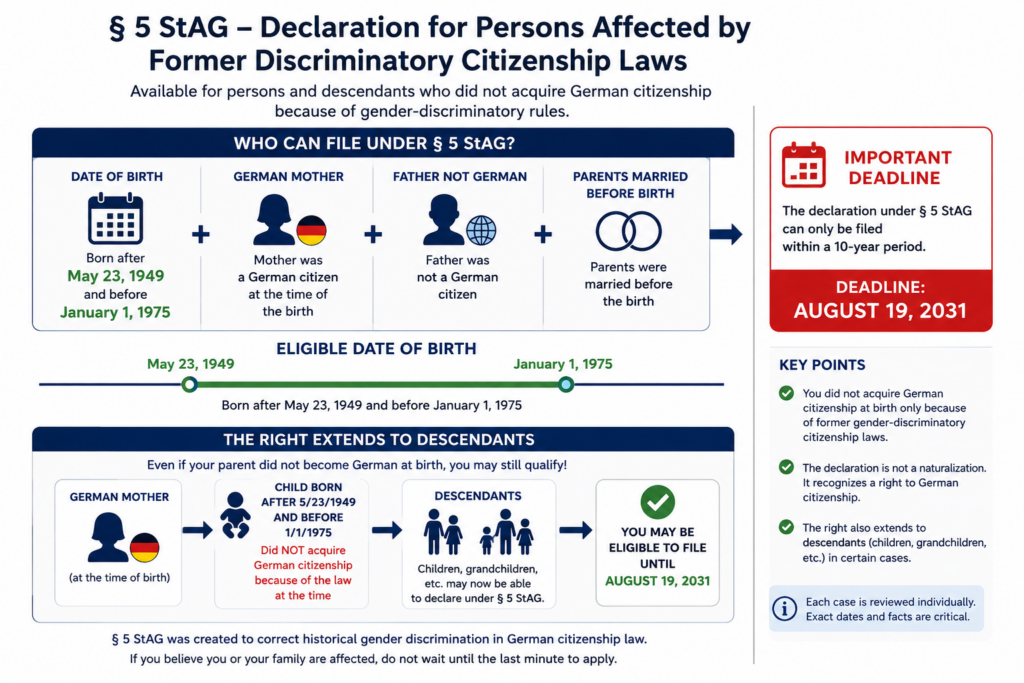
The declaration right expires on August 19, 2031. Five years remain. Anyone who thinks they may qualify should start the review of their declaration of citizenship now, since gathering historical documents from Germany and abroad often takes longer than expected.
The answers below cover the questions we hear most often. Every family history still needs individual review.
1. What is Section 5 StAG and who does it help?
Section 5 StAG allows certain people to become German citizens by declaration, without going through a full naturalization process. It was created to remedy historical rules that prevented German mothers, and in some cases German fathers of children born outside marriage, from passing citizenship to their children.
It covers people born after May 23, 1949, whose parent was German but who did not acquire German citizenship at birth because of these former rules. It also extends to their descendants.
2. My mother was German, but I was born before 1975 and never became German. Can I qualify now?
Possibly, yes. This is the most common situation we see.
Before January 1, 1975, German citizenship passed automatically through the father, not the mother, for children born in wedlock. A child born to a German mother and a non-German father before that date typically did not acquire German citizenship at birth, even though the mother was German.
A key requirement is often overlooked: your mother had to still be a German citizen at the moment you were born. Think of citizenship as a chain that passes from one generation to the next:
German mother → child is born → mother later naturalizes elsewhere
If your mother was still German when you were born, Section 5 StAG can address the fact that the law of the time did not let her pass citizenship to you because of her gender. Whether she naturalized somewhere else later, after your birth, does not change that.
Now reverse the order of events:
German mother → mother naturalizes elsewhere and loses German citizenship → child is born
Here the chain was already broken before you were born, for an ordinary reason unrelated to gender discrimination. Your mother was simply no longer German at the time. Section 5 StAG does not apply to this situation, because there is no discriminatory rule to correct. This is why the exact date of any naturalization is just as important as the date of birth in a Section 5 StAG review.
If you were born after May 23, 1949 and before January 1, 1975, your mother was still German at the time of your birth, your father was not German, and your parents were married before your birth, you generally fall within the core group Section 5 StAG was written to help.
3. My grandmother was German. Can I qualify through her?
Possibly. Section 5 StAG does not only benefit the child directly affected by the old rule. It expressly extends the declaration right to qualifying descendants.
This matters when a German woman had a child during a period when she could not transmit citizenship in the same way a German man could. The fact that your parent never became German does not automatically rule you out.
The same chain logic from the previous question applies one generation further back. We need to confirm your grandmother was still German when your parent was born, not just that she was German at some point in her life. If she had already naturalized elsewhere and lost her German citizenship before your parent’s birth, the chain was broken by naturalization, not by gender discrimination, and Section 5 StAG will not reach that far back.
To qualify as a descendant, we establish the family chain generation by generation: when your grandmother was still German, when your parent was born, whether your grandmother’s naturalization, if any, came before or after that birth, and whether the rule that blocked citizenship at that generation is the kind of historical discrimination Section 5 StAG addresses.
4. What if I was born outside marriage to a German father?
This is a separate category, with a different cutoff date.
Before July 1, 1993, a child born outside marriage generally could not acquire German citizenship automatically through the father, only through the mother. Section 5 StAG also covers people who did not become German at birth for this reason, along with their descendants.
5. Is the 2031 deadline firm?
Yes. The declaration right runs for ten years from the law’s entry into force on August 20, 2021, and expires on August 19, 2031. There is no indication this will be extended.
What matters legally is when the declaration is received by the Bundesverwaltungsamt (BVA), not when it is mailed. Given documentation delays, especially with archival records from Germany or with older U.S. immigration and naturalization files, we recommend starting your declaration of citizenship review well before the deadline rather than close to it.
6. What documents do I typically need?
This varies by family, but common documents include:
- Birth certificates for you, your parent, and in descendant cases your grandparent
- Marriage certificates showing the marital status of the parents at the relevant time
- Marriage certificates for every applicant, along with a divorce decree if applicable
- Proof of the German ancestor’s citizenship, such as a German passport, citizenship certificate, or registration record
- Documentation of any naturalization abroad, including the date
For the naturalization date, we often need the U.S. side of the story as well as the German side. If your German ancestor naturalized as a U.S. citizen, USCIS holds a file on that naturalization called an A-file. You can request a copy of this file through a USCIS FOIA request, submitted online through a USCIS account at first.uscis.gov. The A-file typically shows the exact naturalization date, which is often the single most important date in the case, since it determines whether the chain was already broken before your parent was born. If the ancestor is deceased and naturalized before 1956, the file may sit with the USCIS Genealogy Program instead of the standard FOIA process.
Missing documents are common and do not automatically end a case, but they usually mean more time is needed to gather substitutes or archival evidence.
7. Certified copies vs. notarization: what is the difference, and what will the BVA accept?
Almost every Section 5 StAG case depends on certified copies of documents like birth certificates, marriage certificates, and naturalization records. Many applicants assume a notarized copy from any U.S. notary public satisfies this requirement. It often does not, and the mix-up is one of the most common reasons a submission gets sent back.
German law recognizes a few distinct concepts that all get lumped together as notarization in everyday English:
- Signature certification confirms that a specific person signed a document in front of an official, without reviewing the content.
- Notarial certification is a more formal act under German law, typically performed by a German Notar, where the official reviews the document and explains its legal effect.
- A certified true copy confirms that a photocopy matches an original document. This is the category that matters most here, since the BVA generally works from certified copies rather than original vital records.
A U.S. notary public is not the same office as a German Notar, and typically only certifies signatures and copies without reviewing legal content.
The BVA accepts certified copies and certified signatures from a notary public based in the United States, with two conditions:
- When certifying a copy, the notary public must add a statement confirming the copy matches the original, commonly worded as “I certify this to be a true copy of the original,” along with their seal and signature. A notary stamp alone, without this statement, is often not sufficient.
- Copy certifications from a notary public in California or New York are not accepted by the BVA. If you live in either state, or your documents were notarized there, plan to have copies certified by a German consulate, embassy, or honorary consul instead.
German missions in the United States and honorary consuls will certify copies and signatures for citizenship matters at no charge, and this is often the more reliable route. Signature certifications require you to appear in person with a valid passport, national ID card, or U.S. driver’s license, whether you go to a notary public or a German consulate.
An apostille is a separate step from certification. It confirms that a public document, such as a U.S. birth or marriage certificate, was issued by a legitimate government authority, so that it can be recognized in another country. Apostilles are issued by the Secretary of State’s office in the state where the document was issued, not by a notary public. For documents from the U.S. that will be used for this purpose, you generally do not need the apostille on the original public document itself, a certified copy is sufficient.
8. Can I apply for my children at the same time?
In many cases, yes. If you qualify under Section 5 StAG, your minor children may be included in the same process.
9. My family looked into this years ago and it did not go anywhere. Should I look again?
Section 5 StAG in its current form has only existed since 2021, and the rules on who qualifies as a descendant are broader than many of the earlier, narrower remedies that existed before it. A case that did not fit an older program may still fit under the current version of Section 5 StAG.
If you are not sure whether you qualify, or which documents you will need, the fastest way to find out is to complete our pre-consultation screening questionnaire. Your answers help us determine whether a consultation with German attorney Christine Stenner is the right next step for your case.
At Stenner Law, we are specialists in German citizenship for Americans with German roots. We speak both German and English, and we have lived in both countries, which means we understand not only the legal side of these cases but also the practical work of tracking down old documents on both sides of the Atlantic. If you think you may qualify, the fastest way to find out is to complete our pre-consultation screening questionnaire. Your answers help us determine whether a consultation with German attorney Christine Stenner is the right next step for your case.
You can also reach us at office@stennerlaw.com
Or call our office at (215) 770-9488
We will review the information and let you know whether your case appears to meet the basic requirements for a consultation.
About the author
Christine Stenner is a German attorney with 30 years of experience. She is admitted to practice German law in the United States and focuses exclusively on German citizenship law for clients living in the United States. At STENNER LAW, she assists applicants with restoring or reclaiming German citizenship through declaration, re-naturalization, and restitution-based applications.