By Christine Stenner, German Attorney in the United States at Stenner Law| Foreign Legal Consultant (PA) | July 5, 2026
German citizenship by restitution under § 15 StAG is one of the least known pathways to German citizenship. While many people are familiar with Article 116(2) of the German Basic Law, far fewer know that § 15 StAG provides a separate legal right to German citizenship for victims of Nazi persecution and their descendants who are not covered by Article 116(2).
The provision is § 15 of the Staatsangehörigkeitsgesetz (StAG), was enacted in 2021 and fills a gap that had left thousands of families without a viable path to restoration for decades.
Why § 15 StAG Was Necessary
Article 116(2) of the Basic Law requires a formal act of deprivation, which requires that German citizenship was held before. That standard excluded a large group of people who suffered exactly the same harm but through different legal mechanisms.
Here are three typical examples that did not qualify in the past but now do:
A German Jewish woman fled to the United States in 1938 and married an American man shortly after arriving. Under the law in effect at the time, marriage to a foreign national caused automatic loss of German citizenship. She was never formally “denaturalized” by the Nazi state, so Article 116(2) did not apply to her, even though her departure was entirely persecution-driven.
A Jewish family from the Sudetenland, which was incorporated into the Reich in 1938, was excluded from the mass naturalization of ethnic Germans that followed. The relevant Nazi decree explicitly stated that Jews and Roma did not qualify. They never held German citizenship in the first place, because the very process that would have made them German citizens was closed to them on racial grounds.
A Polish-born man had lived in Berlin since 1921 and remained stateless throughout the Weimar Republic. He had every reason to expect naturalization and had, in fact, begun the process. He was expelled from Germany in 1939. Article 116(2) could not help him because he had never held German citizenship to begin with.
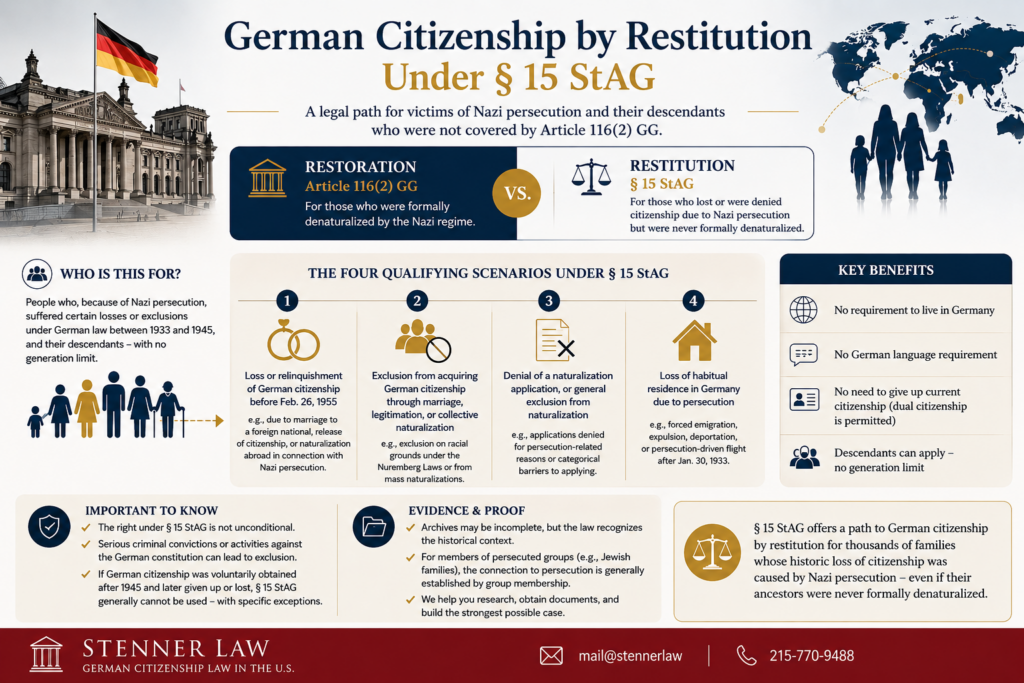
§15 StAG was designed to address precisely these situations. It does not require a formal act of deprivation. It requires a connection between Nazi persecution and one of four specific legal outcomes.
The Four Qualifying Scenarios
§15 StAG covers four distinct situations:
- Loss or relinquishment of German citizenship before February 26, 1955. This applies to people who lost citizenship through ordinary legal mechanisms, such as marriage to a foreign national, voluntary release from citizenship, or naturalization abroad, when that loss occurred in connection with Nazi persecution. The connection does not have to be direct. If someone fled Germany due to persecution and then obtained foreign citizenship in their country of refuge, the connection to persecution is generally presumed.
- Exclusion from acquiring German citizenship through marriage, legitimation, or collective naturalization. This covers people who would have become German citizens under normal rules, but were excluded on racial grounds. The Nuremberg Race Laws of 1935 introduced the concept of Reich citizenship for persons of “German and related blood” only. Jewish spouses, legitimated children, and those excluded from the Eastern territory mass naturalizations all fall here.
- Denial of a naturalization application, or general exclusion from naturalization. This applies to non-German nationals who had applied to become German citizens and were denied for persecution-related reasons, or who were categorically barred from applying at all. For instance, Jewish applicants and others who were systematically excluded, membership in the persecuted group itself establishes the necessary connection. No individual proof of the specific grounds for denial is required.
- Loss of habitual residence in Germany due to persecution. This covers non-Germans who had established their primary residence in Germany before January 30, 1933, and who lost that residence through forced emigration, expulsion, deportation, or persecution-driven flight. By leaving, they lost any realistic prospect of ever naturalizing.
Descendants: No Generation Limit
One of the most significant features of § 15 StAG is how it treats descendants. The right to apply for German citizenship is not limited to the children or grandchildren of those directly affected. There is no generation cut-off. Here is an example:
A woman born in New York in 1975 contacts me. Her grandmother was a German Jewish woman who fled to the United States in 1936 and married an American man in 1937, losing her German citizenship through that marriage. The grandmother never applied under any earlier law because the deadlines passed before she understood her rights. Under § 15 StAG Nr. 1, the grandmother qualifies. The New York-born woman is a descendant under the statute. She can apply.
How § 15 StAG Differs From Article 116(2)
Article 116(2) of the Basic Law remains the stronger provision where it applies. It operates at the constitutional level and requires no further legislative action. But it is limited to people who were formally denaturalized by the Nazi state, and their descendants.
§ 15 StAG operates at the statutory level and extends to people who were never formally denaturalized but who suffered an equivalent loss. The two provisions work in parallel, and in many cases a family’s history will need to be analyzed under both to determine which applies, or whether both might.
Neither provision requires the applicant to live in Germany, to speak German, or to give up their current citizenship. Germany has always permitted dual citizenship in these restoration cases.
What Disqualifies an Applicant
The right under § 15 StAG is not unconditional. An applicant is excluded if they have been convicted of one or more intentional offenses and sentenced to at least two years’ imprisonment, or if a court ordered preventive detention at the last sentencing. Membership in organizations hostile to the German constitution can also be grounds for denial.
There is also an important rule for those whose families re-acquired German citizenship after 1945 and then lost it again. If someone obtained German citizenship after the war ended and subsequently relinquished or lost it voluntarily, they and their descendants generally cannot use § 15 StAG to restore it. The statute addresses historical persecution-era harm, not subsequent choices.
There is one exception to that rule: if the post-1945 loss occurred because a woman married a foreign national, or because a child was legitimated by a foreign father, the claim is not barred. Those loss provisions were themselves unconstitutional under German gender equality law, and the legislature chose not to penalize applicants for them.
Evidence and Proof
Many families approach this process worried about documentation. Records were destroyed, archives are incomplete, and the people who lived through those years are no longer here to describe what happened. First of all, we at STENNER LAW search for you in archives, such as Yad Vashem, the central database for Shoa Victim’s names, or Arolsen Archives, the largest archive on victims and survivors of Nazi persecution.
If we find information, we are in most cases able to obtain official documents from German official archives, such as birth certificates, marriage certificates, or resident registration cards that were used to identify nationality.
When it comes to facts related to those who belonged to groups that were systematically targeted, including Jewish families, the connection to persecution is generally established by group membership alone. Evidentiary standards are not set so high that the restorative purpose of the statute is defeated. For instance, no one is expected to produce a 1939 rejection letter from a German naturalization office for a Jewish resident.
That said, building a well-documented application still matters. The more evidence is available, the cleaner the path through the process. This is why we at STENNER LAW aim to present a case with sufficient evidence to back up all facts relevant for immediate approval. This way, our cases leave no to little room for additional questions which speeds up the process significantly.
Is This Relevant to Your Family?
If your family belonged to a group of people who were systemically
- persecuted by the Nazi’s,
- lived in Germany already before 1933, and
- left Germany between 1933 and 1945,
- § 15 StAG may apply to you, even if it turns out they never obtained German citizenship.
Each case turns on specific facts: the ancestry line, the nature of the loss or exclusion, the timing, and the documentation available.
I have worked with German citizenship cases for many years and am familiar with the authorities on both the Article 116(2) and § 15 StAG sides of this area. If you have questions about whether your family history may support a claim, I am glad to speak with you.
About the author
Christine Stenner is a German attorney with 30 years of experience. She is admitted to practice German law in the United States and focuses exclusively on German citizenship law for clients living in the United States. At STENNER LAW, she assists applicants with restoring or reclaiming German citizenship through declaration, re-naturalization, and restitution-based applications.